Crystal Grid Design Training
Professional training in intentional crystal arrangements for home, office, studio, and wellness spaces. Learn how to translate Crystal Energy Technology principles into structured spatial design using intention, room assessment, orientation, proportion, the Five Elements, and repeatable activation and closing protocols.
Intentional Spatial Design, Not Decorative Placement.
Within the Tula Science method, a crystal grid is an intentional arrangement of crystals placed in relationship to one another and to the architecture of a space. The arrangement may use a center point, perimeter anchors, directional stones, elemental stations, or a combination of these.
Purpose
Every grid begins with one clear reason for being created.
Architecture
The room determines what is possible. Place comes before symbolism.
Coherence
Every placement should belong to one intentional visual and contemplative structure.
Built on Crystal Energy Technology.
Enrollment requires prior completion of the Crystal Energy Technology Training. This advanced training assumes familiarity with crystal selection and care, facilitator preparation, the Five Elements framework, responsible practice, and the distinction between contemplative language and medical or scientific claims.
Ideal For
Practitioners and individuals applying crystal-grid principles in:
- Homes and private rooms
- Personal and professional offices
- Studios and meditation spaces
- Wellness and treatment environments
From Room Assessment to Responsible Professional Practice.
Room Assessment
Function, movement, focal points, boundaries, sensory conditions, and intention.
Core Grid Method
Center, four anchors, directional relationships, and circuit.
Home & Office Applications
Desks, bedrooms, entrances, meeting rooms, studios, and wellness spaces.
Five Elements Design
Earth, Water, Fire, Air, and Ether as symbolic spatial qualities.
Activation & Maintenance
Opening, documenting, reviewing, adjusting, and closing a grid responsibly.
Professional Practice
Consent, safety, documentation, troubleshooting, and appropriate language.
Five Principles Guide Every Grid.
| Principle | Meaning |
|---|---|
| Purpose | Every grid begins with one clear reason for being created. |
| Place | The room itself determines what is possible. Architecture comes before symbolism. |
| Proportion | The number and scale of stones should fit the room. More is not automatically stronger. |
| Relationship | Stones are selected and positioned as parts of one coherent arrangement. |
| Presence | The practitioner's attention, responsibility, and consistency matter more than spectacle. |
Read the Room Before You Place a Stone.
A responsible grid begins with observation, not assumption.
| # | Assessment | Question |
|---|---|---|
| 1 | Function | What is this room actually used for? |
| 2 | People | Who uses it, how many people, and for how long? |
| 3 | Movement | Where do people enter, exit, sit, stand, meet, rest, or concentrate? |
| 4 | Center | Is there a natural center or focal point? |
| 5 | Boundaries | What are the corners and edges of the functional zone? |
| 6 | Sensory Conditions | Observe light, noise, airflow, scent, temperature, and visual clutter. |
| 7 | Intention | What quality does the owner or practitioner want the room to support? |
Center. Four Anchors. One Coherent Circuit.
The foundational room grid uses one Center Stone and four Anchor Stones. Directional points may be added as a second layer when practical and safe. The geometry serves the room — not the other way around.
Core Sequence
- Prepare and assess the room.
- Define the intention in one sentence.
- Choose a practical center.
- Place the Center Stone.
- Place four Anchor Stones around the functional zone.
- Confirm safety, proportion, and visual coherence.
- Document placement and date.
Adapt the Method to the Function of the Room.
Home
Entrance, living room, bedroom, meditation room, creative studio.
Office
Personal desk, private office, meeting room, reception, professional workspace.
Wellness Spaces
Grid the room rather than the client's body, while maintaining scope, safety, and consent standards.
A Symbolic Spatial Design Framework.
| Element | Training Quality | Spatial Feeling | Grid Stone |
|---|---|---|---|
| Earth | Stability • Support • Patience • Discernment | Grounded, stable, substantial | Zebra Jasper / Smoky Quartz |
| Water | Fluidity • Receptivity • Gentleness • Emotional balance | Flowing, reflective, adaptable | Aquamarine |
| Fire | Clarity • Courage • Vitality • Transformation | Warm, directed, activating | Sunstone |
| Air | Mental clarity • Inspiration • Freedom • Communication | Open, light, breathable | Clear Quartz |
| Ether | Space • Unity • Stillness • Integration | Uncluttered, quiet, connective | Selenite / Clear Quartz |
These correspondences are part of the Tula Science training framework and are not presented as universal scientific mineral classifications.
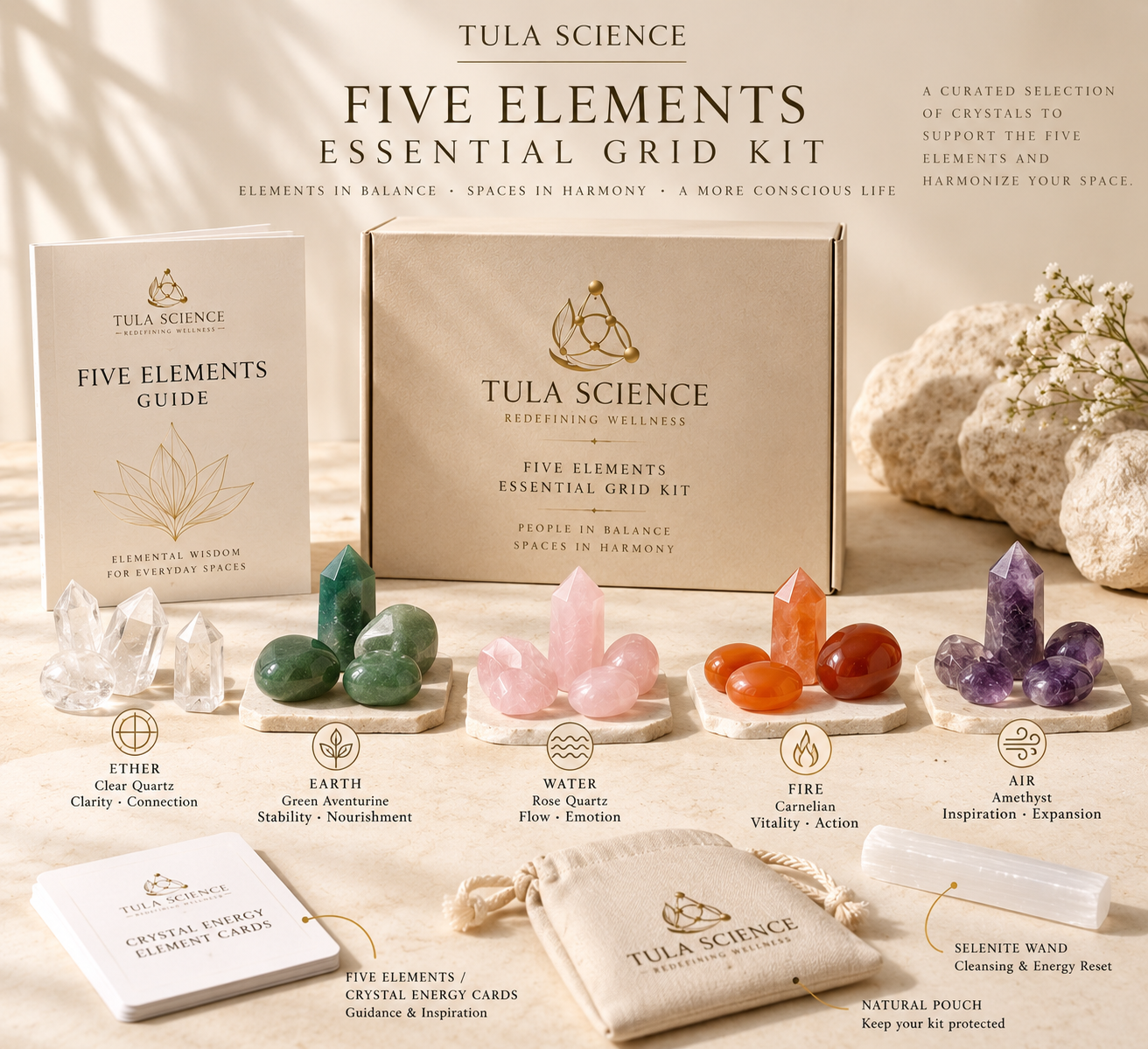
The Foundational Kit for the Core Room-Grid Method.

Participants may assemble their own materials or order the curated kit through TulaScience.com, subject to availability and natural variation.
Build Elemental Room Grids With a Structured System.
Design for One Quality — or Balance All Five.
Earth
Stability, patience, clarity, and grounded action.
Water
Fluidity, receptivity, gentleness, and wise adaptation.
Fire
Clarity, courage, vitality, and conscious action.
Air
Clear thought, inspiration, freedom, and communication.
Ether
Stillness, unity, spaciousness, and integration.
Complete Five Elements Grid
Five stations designed for balance and integration, adapted to the architecture and purpose of the room.
Activation
Confirm safety, state the purpose, acknowledge center and anchors, inspect the perimeter, and end with a moment of silence.
Maintenance
Clean stones appropriately, verify placements remain safe, review intention, update the grid map, and adjust after room changes.
Closing
State that the grid is complete, remove stones in reverse order, inspect each piece, restore the space, and document the closing date.
“Activation” in this training means formally beginning the intentional use of the arrangement; it is not presented as switching on a scientifically verified field.
Safety, Consent, and the Function of the Space Come First.
The training emphasizes grounded, responsible practice in both private and shared environments.
- Ask permission before placing crystals in shared or controlled spaces.
- Respect workplace, property, accessibility, and cultural requirements.
- Never hide stones where they may create hazards or confusion.
- Keep crystals away from children, pets, door tracks, heat sources, and unstable ledges.
- Do not diagnose a room or attribute illness, conflict, or financial problems to an energetic condition.
- Use appropriate, neutral language in professional environments.
Five Labs Turn the Method Into Applied Skill.
| Lab | Assignment |
|---|---|
| 1 — Personal Desk Grid | Create a 3–5 stone micro-grid for one work intention and review after three workdays. |
| 2 — Five-Point Room Grid | Install the foundational center + four-anchor grid in one home room and document safety, scale, and intention. |
| 3 — Single Element Grid | Choose Earth, Water, Fire, Air, or Ether and design a room around that quality without overdecorating. |
| 4 — Complete Five Elements Grid | Create and document a balanced five-element installation and explain why each placement belongs. |
| 5 — Professional Adaptation | Design a hypothetical office or wellness-room grid using neutral professional language and a written scope statement. |
A Structured Learning System You Can Revisit.
Recorded Training
Learn the complete method through structured recorded instruction.
Professional Training Manual
Study the full framework, protocols, applications, documentation tools, and practice assignments.
Applied Practice
Complete the required labs and use the method in practical home, office, and wellness-space scenarios.
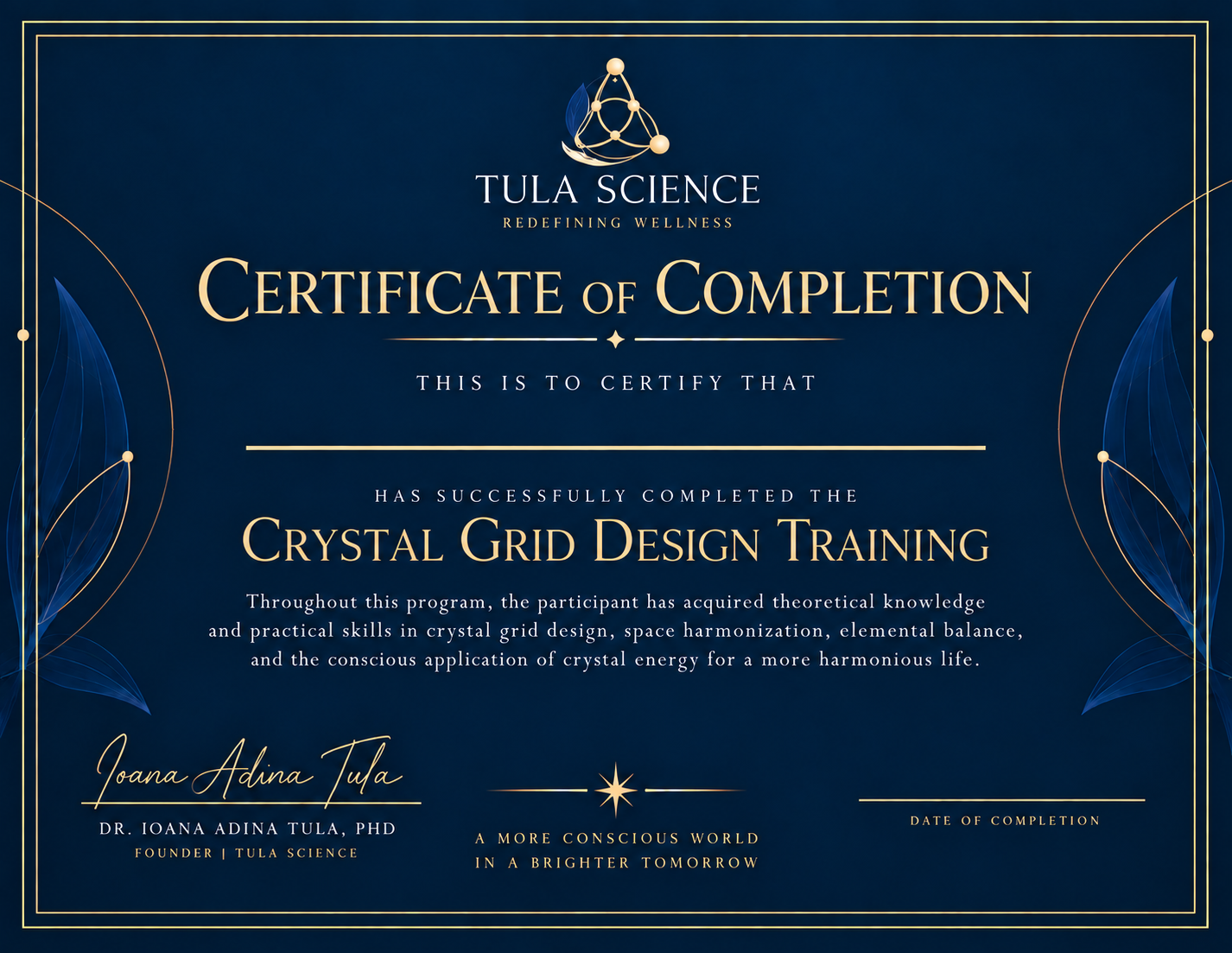
Recognize Your Completion of the Training.
Participants who complete the recorded training, manual study, and required practice assignments may receive a Certificate of Completion for Crystal Grid Design Training according to Tula Science Education program requirements.
The certificate recognizes educational completion and does not constitute a medical, clinical, architectural, engineering, interior-design, or other regulated professional license.

Dr. Ioana Adina Tula
Scientist • Bio-Formulator • Spiritual Wellness Guide
Through Tula Science Education, Dr. Tula integrates structured learning, contemplative practice, responsible energetic language, and practical spatial design. The Crystal Grid Design Training is built to be thoughtful, repeatable, safety-conscious, and appropriate for real environments.
Continue Your Tula Science Training Path.
Crystal Grid Design Training is an advanced program. Prior completion of Crystal Energy Technology Training is required before enrollment.
Continue Your Tula Science Training Path.
Crystal Grid Design Training is an advanced program. Prior completion of Crystal Energy Technology Training is required before enrollment.
Frequently Asked Questions
Yes. Prior completion is a prerequisite for this advanced training.
No. Participants may assemble their own materials or order the curated kits when available.
No. The certificate recognizes educational completion and is not a regulated professional license.
No. Energetic language is used as a symbolic and experiential framework.
Yes, within appropriate property rules, consent, accessibility, workplace policies, cultural considerations, and legal scope.
Design With Intention. Observe With Discernment. Place With Purpose.
Crystal Grid Design Training offers a structured method for translating intention, room function, spatial observation, and the Five Elements into thoughtful crystal arrangements for real environments.
View Enrollment DetailsEducational, contemplative, spiritual, design and wellness-oriented training. Energetic language is used as a symbolic and experiential framework and is not presented as a scientifically measured room effect or a guaranteed medical, psychological, environmental, or business outcome.