
01 / 09
The Quiet Threshold
A thoughtfully prepared entrance that helps the mind transition from everyday activity into stillness.
A professional, self-paced training for people who want to intentionally prepare meditation spaces and facilitate contemplative experiences with greater structure, presence, safety, and responsibility. Learn what to consider before the first participant enters the room — and how to guide the experience once they do.
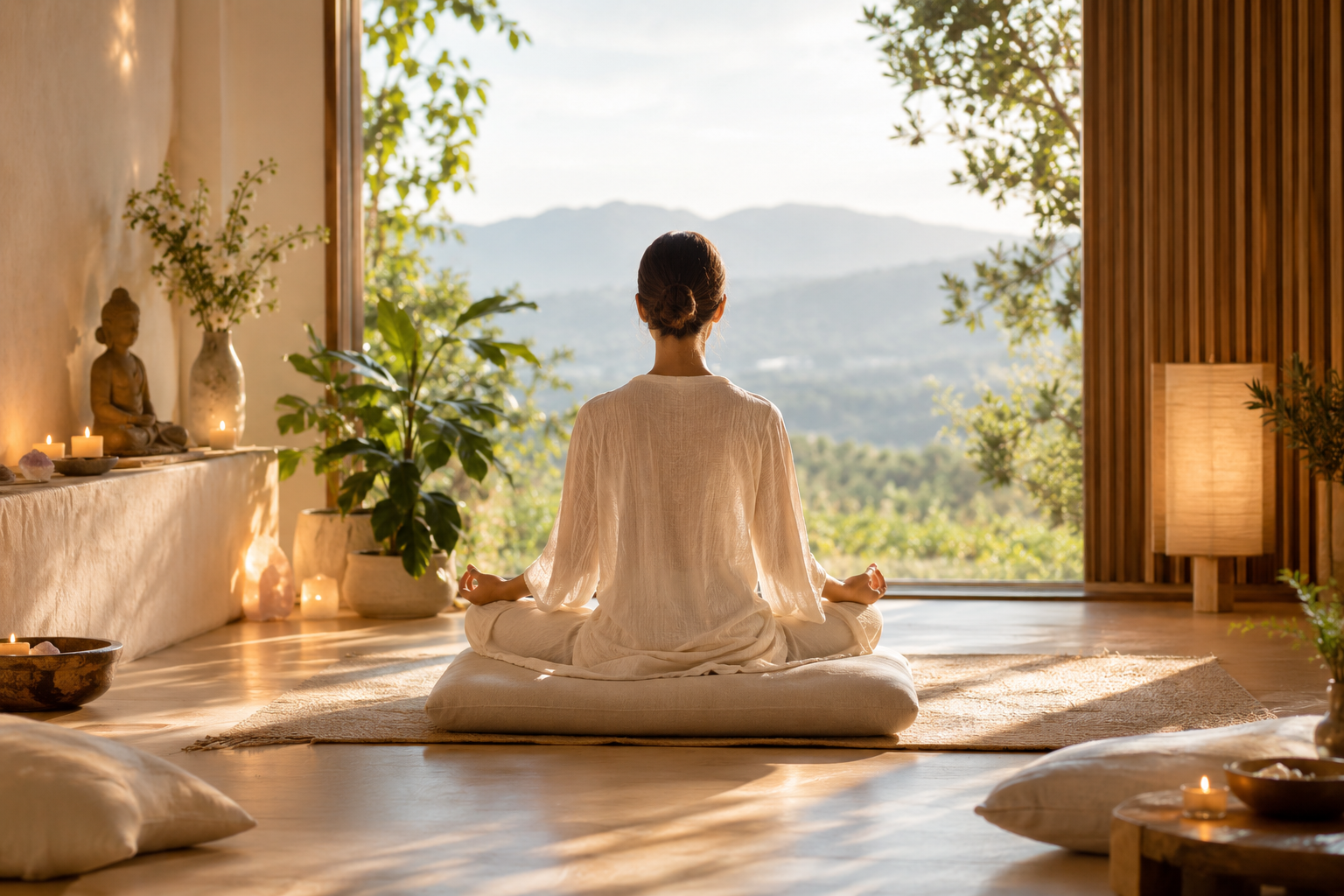
It is easy to focus on how a meditation room looks. Professional facilitation asks deeper questions: What does the body experience on entering? Does the participant feel respected? Is the facilitator settled? Are symbols appropriate to the context? Is the session structured safely and clearly?
Light, air, sound, temperature, order, seating, accessibility, and sensory clarity all matter before the practice begins.
A beautiful environment cannot compensate for haste, pressure, judgment, unclear boundaries, or lack of participant freedom.
Your presence, preparation, listening, voice, discernment, and professional limits become part of the experience you are creating.
A meditation space is a physical and relational environment intentionally created to support stillness, attention, reflection, and presence under conditions of safety, respect, and inner freedom.
Explore silence, presence, the Body–Soul–Spirit pedagogical framework, and the role of contemplative practice in personal development.
Develop humility, listening, calm communication, intention, discernment, and the ability to accompany without controlling.
Learn how light, temperature, order, textures, seating, sound, symbolic elements, and relational atmosphere shape the experience.
Understand dignity, spiritual freedom, confidentiality, professional limits, non-dependency, and when referral is appropriate.
Study contemplative scripts and how to guide breathing, posture, silence, intention, and integration without forcing experience.
Use a complete 60-minute session structure from preparation through welcoming, practice, integration, and closing.
The training looks beyond décor and teaches four dimensions that work together to shape contemplative experience.
Light, temperature, air, order, textures, chairs, cushions, plants, and everything the body perceives before conscious analysis begins.
How participants are welcomed, listened to, looked at, respected, and given room to participate without pressure.
The facilitator's breath, presence, stillness, prayer or reflection, and capacity to enter the session without projecting agitation.
Objects such as candles, flowers, icons, books, or other symbols used appropriately to context and without imposing beliefs.
The visual language of the training favors calm, order, natural light, proportion, and breathing room — not spectacle or decorative excess.


Voice, breath, gaze, patience, listening, and presence all become part of the environment participants experience. The training teaches facilitators to prepare themselves with the same care used to prepare the room.
| Level | Focus |
|---|---|
| I — Physical Cleanliness | Flooring, surfaces, ventilation, temperature, seating, lighting, water, restrooms, accessibility. |
| II — Sensory Clarity | Reduce unnecessary visual, auditory, and sensory stimulation. |
| III — Relational Clarity | Check the facilitator's own emotional state, presence, and readiness. |
| IV — Spiritual Preparation | Use context-appropriate practices from the participant's tradition without imposing them. |
| V — Consecrating the Intention | Prepare the heart and clarify the purpose of the meeting. |
The training introduces the Inner Temple as a living metaphor for order, attention, and availability — not an anatomical place or energy center.
The training presents perspectives from Orthodox Christian and Indian contemplative traditions while preserving the distinct identity, theology, philosophy, and practice framework of each.
Prayer, inner stillness, watchfulness, humility, the heart, and relationship with God are presented within their own Christian framework.
Stillness of mind, disciplined attention, devotional practice, and related contemplative concepts are presented within their own context.
A clear structure supports safety, flow, and consistency while leaving room for the facilitator's authentic style.
| Stage | Focus | Approx. Time |
|---|---|---|
| I | Space preparation | 15–30 min before |
| II | Welcoming participants | 5 min |
| III | Introduction | 5 min |
| IV | Setting an intention | 3 min |
| V | Settling the body | 5 min |
| VI | Conscious breathing | 5 min |
| VII | Contemplative practice | 20 min |
| VIII | Returning | 5 min |
| IX | Integration | 7 min |
| X | Closing | 5 min |
The training addresses crying, sleep, panic, trembling, unusual images or experiences, spiritual interpretations, requests to stop medical treatment, dependency on the facilitator, and situations that exceed the facilitator's scope.
Professional instruction you can complete at your own pace.
A downloadable PDF supporting the full facilitator-training framework.
Return to the training materials whenever you need to review or refresh your practice.
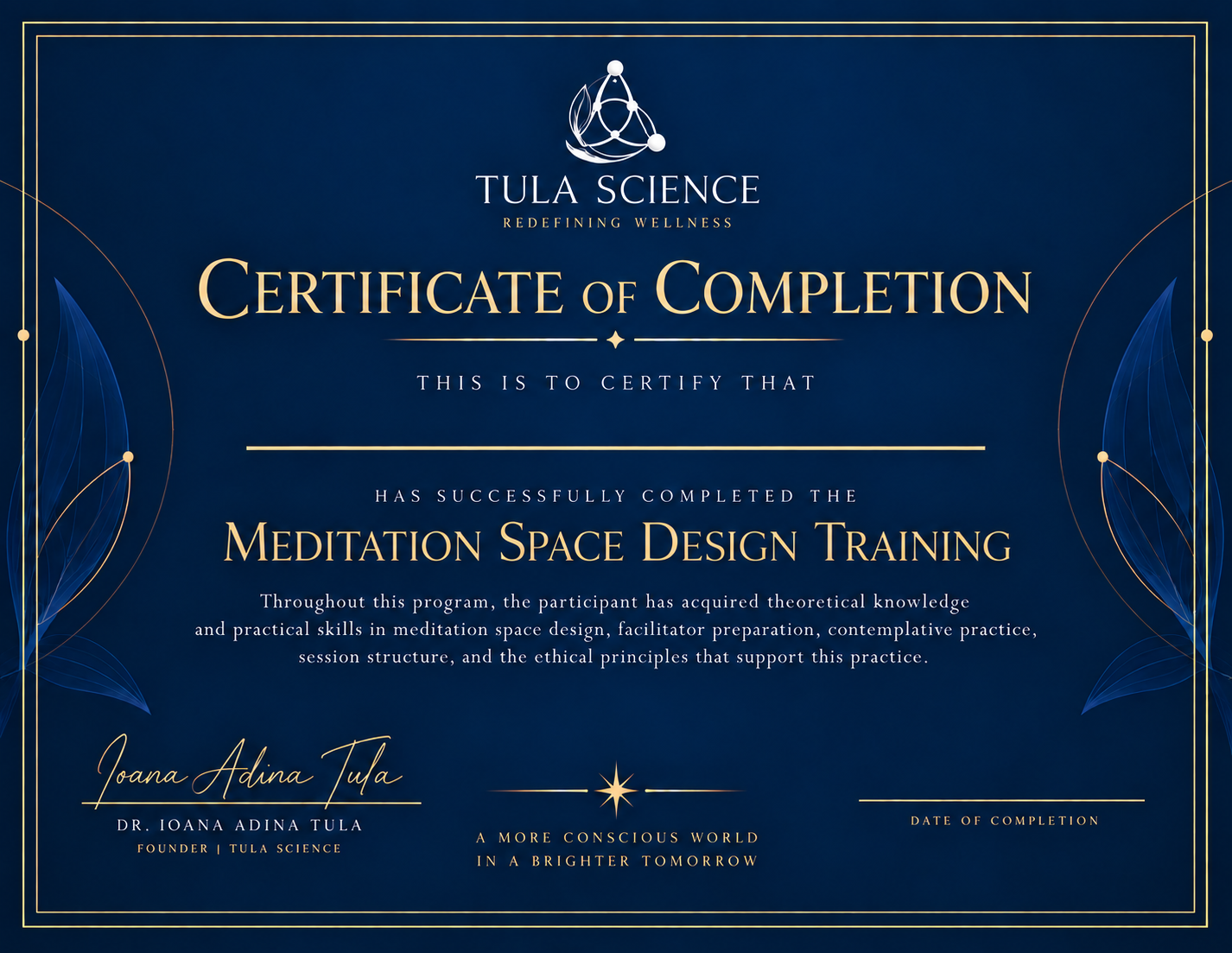
Participants who successfully complete the educational training receive a Certificate of Completion for Meditation Space Design Training.
The certificate recognizes educational completion and does not constitute a medical, psychological, psychotherapeutic, or other regulated professional license.

Scientist • Formulator • Spiritual Wellness Guide
Through Tula Science Education, Dr. Tula brings together scientific discipline, contemplative practice, facilitator ethics, intentional space design, and responsible professional boundaries in a practical training framework for modern contemplative settings.
You are not simply learning how a meditation room should look. You are learning how the environment, your own preparation, the participant relationship, and the structure of a session work together.
Get the complete Meditation Space Design Training with the professional manual, lifetime access, practical facilitation framework, and Certificate of Completion.
No prerequisites. Begin at your own pace and return to the material whenever you need it.
Enroll Now — $195Enrollment opens on wednesday, October 7. Please return on October 7 to continue your Tula Science Training Path.
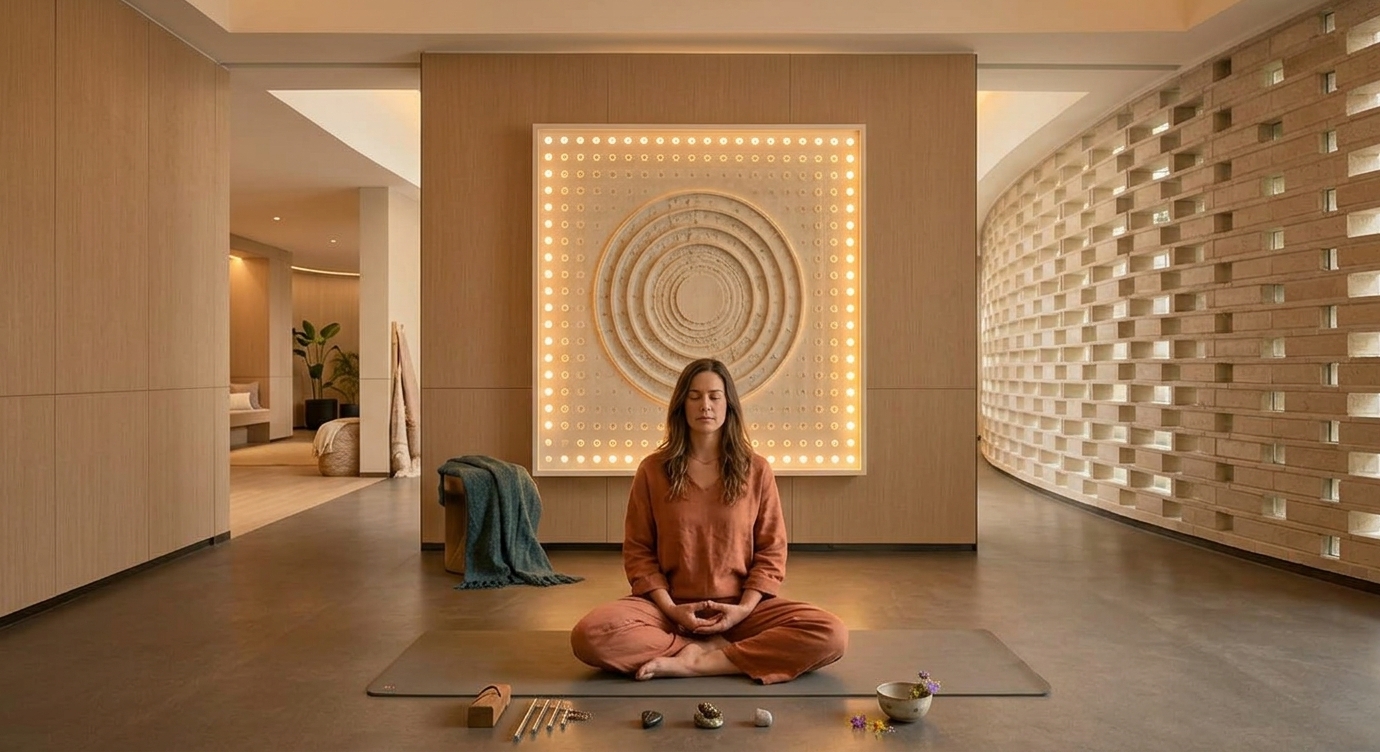
Explore the atmosphere, balance and intentional details behind a thoughtfully prepared meditation environment.
A thoughtfully prepared entrance that helps the mind transition from everyday activity into stillness.

Natural light, restrained materials and open space create a calmer visual rhythm.

Simple seating and intentional spacing make the environment feel welcoming without distraction.

A balanced composition of texture, warmth and negative space designed for contemplative practice.

Minimal elements create room for attention, reflection and a deeper sense of presence.

Every visual element has a purpose: comfort, orientation, calm and respectful preparation.

Organic textures and subtle details bring warmth into a space without overwhelming it.

A clear visual focal point can gently guide attention while preserving simplicity.

A calm, human-centered environment designed to feel peaceful, grounded and intentional.
It is designed for people who want a structured educational framework for preparing meditation spaces and responsibly facilitating contemplative practices, whether for personal-development settings, wellness spaces, groups, or individual practice.
No. The training explains that a meditation space can be created in many settings, including an office, classroom, home, church, outdoor environment, or a simple dedicated corner. The emphasis is on intention, safety, simplicity, and appropriate preparation.
No. The method can be adapted to different contexts while respecting spiritual freedom. The training studies Orthodox Christian and Indian contemplative perspectives distinctly and also addresses neutral contemplative settings.
Tula Science categorizes this offering as Professional Training.
No. Meditation Space Design Training has no prerequisite.
No. It is recorded, self-paced, and available online with lifetime access.
Yes. A complete downloadable training manual is included with enrollment.
Yes. Participants who successfully complete the training receive a Certificate of Completion.
No. The certificate recognizes educational completion only and does not constitute a medical, psychological, psychotherapeutic, or other regulated professional license.
No. The training presents both respectfully while preserving the distinct spiritual and philosophical framework of each.
Learn to prepare the environment, prepare yourself, guide responsibly, and create contemplative experiences rooted in simplicity, dignity, presence, and discernment.
Enroll — $195Meditation Space Design Disclaimer:
Meditation Space Design is an educational, contemplative, spiritual, and design-oriented program focused on creating intentional environments that support meditation, reflection, mindfulness, and personal practice. References to energy, vibration, consciousness, sacred geometry, symbolism, atmosphere, or related concepts are presented as spiritual, contemplative, traditional, symbolic, or experiential frameworks. They are not presented as scientifically measured effects of a particular room, design element, material, or arrangement. The program is not medical, psychological, psychiatric, therapeutic, architectural, or clinical treatment and is not a substitute for professional medical advice, diagnosis, psychotherapy, counseling, licensed healthcare services, or qualified architectural, engineering, or safety advice. Meditation spaces and design practices taught in this program are not intended to diagnose, treat, cure, or prevent any disease or health condition and do not guarantee any specific physical, psychological, emotional, environmental, professional, or business outcome. Individual experiences may vary. Participants are responsible for considering appropriate safety, accessibility, ventilation, lighting, electrical requirements, fire safety, physical space limitations, and other applicable building or environmental requirements when creating or modifying a meditation space. Completion of the program and any Certificate of Completion recognize participation in an educational program and do not constitute a medical, clinical, therapeutic, architectural, engineering, or other professional license or qualification.